| Michigan Tech Home | Department of Geological Engineering & Sciences | Remote Sensing Institute | MTU Volcanoes Page | Volcanic Clouds Web Site | Total Ozone Mapping Spectrometer (TOMS) | Volcanic Ash Advisory Centers (VAAC) | Smithsonian Institution | Alaska Volcano Observatory |
Main
Topics
Subtopics
ASHFALL FORECASTS
Forecasting ashfall is a difficult but very important task that involved the understanding of many disciplines. Ash particles produced during an eruption can remain in the atmosphere for days and have been attributed to many health and machinery problems.
Why are forecasts of ashfall important?
The volcanic ash that is created during an eruption can be hazardous to one's health. Fine ash can remain airborne for long periods of time and upon falling out, are easily resuspended by wind or human activities such as driving. Fine ash that is inhaled can lead to a number of serious health effects including silicosis of the lungs, respitory problems such as asthma and fluorosis.
Many governments have incorporated an upper limit of the
concentration of fine particles an individual should inhale before
it becomes a health risk. In the United States, the
Environmental Protection Agency has incorporated Particulate
Matter Standards in an attempt to quantify the amount of
particluate matter at specifice size intervals that may be
hazardous. The standard for PM10, or particulate 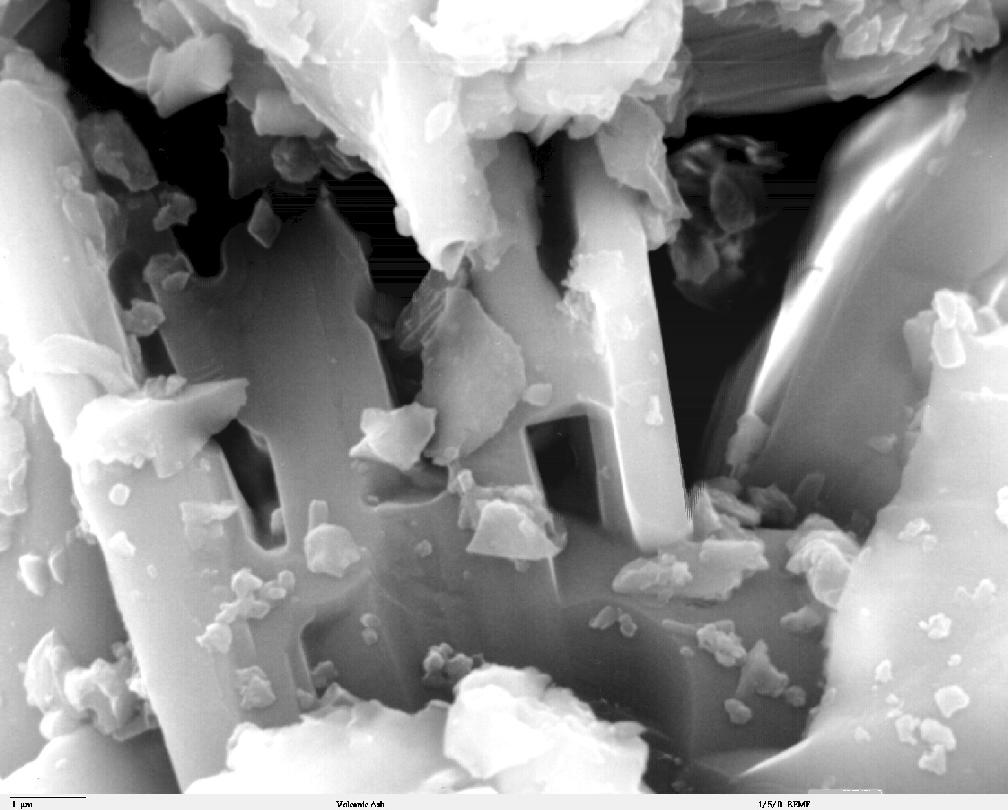 matter
of 10 microns or less, is not to exceed 50 mug/m3 per year
averaged over 3 years and not to exceed 150mug/m3 more than once
per year averaged per three year period.(i'm not really sure how
they calculate the 24 hr standard...something about 99th%ile).
Likewise the PM2.5 for the annual and 24 hour standard is 15
mug/m3 and 65 mug/m3 respectively.
matter
of 10 microns or less, is not to exceed 50 mug/m3 per year
averaged over 3 years and not to exceed 150mug/m3 more than once
per year averaged per three year period.(i'm not really sure how
they calculate the 24 hr standard...something about 99th%ile).
Likewise the PM2.5 for the annual and 24 hour standard is 15
mug/m3 and 65 mug/m3 respectively.
Ash also presents a problem to machinery and
structures. The average weight of ash 1 inch deep is 10 lbs
per square foot. Significant ashfall can therefore easily
collapse structures.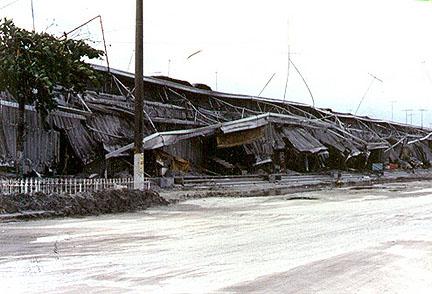 Also, if volcanic ash is encountered by an aircraft
significant damage
can be incurred because the ash can be remelted in engines and
shut them down or cause corrosion to numerous parts of the
aircraft. In fact, the awareness of the threat of volcanic
clouds to aircraft has become large enough that 9 Volcanic
Ash Advisory Centers have been set up around the world to
inform aviators of the presence of volcanic ash and its projected
movement.
Also, if volcanic ash is encountered by an aircraft
significant damage
can be incurred because the ash can be remelted in engines and
shut them down or cause corrosion to numerous parts of the
aircraft. In fact, the awareness of the threat of volcanic
clouds to aircraft has become large enough that 9 Volcanic
Ash Advisory Centers have been set up around the world to
inform aviators of the presence of volcanic ash and its projected
movement.
How is Ashfall Forecasted?
For the most part, geologists have a strong understanding of how large particles fall from an ash cloud. Typically, these particles fall out in a matter of hours. The behavior of fine ash particles however is poorly understood. These particles can remain in the atmosphere for days but frequently fall out surprisingly quickly due to mechanisms that are poorly understood.
Ashfall can be predicted using information about the eruption,
the erupted particles and local wind vectors at a variety of
altitudes. The amount of time a particle takes to falls
depends on the height at which it was erupted and its terminal
velocity in the atmosphere. The particle falls from
altitudes above the vent and 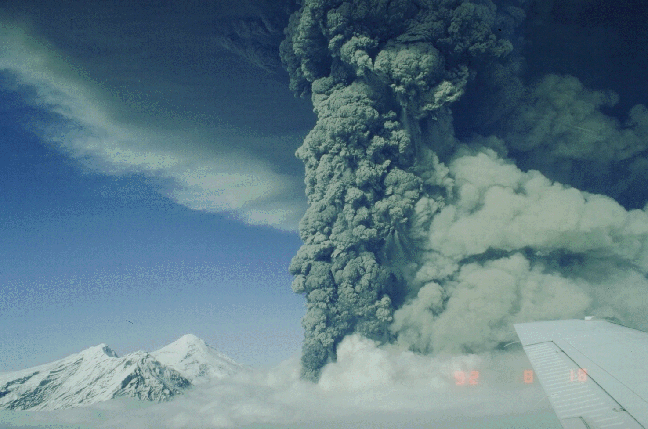 below
the top of the eruption column. The altitude of the vent can
be attained from online databases such as the Smithsonian
Institution or from a local topographic map of the region. The
height of the eruption column can be either visually esitmated or
calculated from remotely sensed data. Once the range of
starting altitudes has been determined, the rate the particle will
fall from a given altitude can be calculated according to
properties of fluid
mechanics. The forces acting on the particle are dependant
upon on the dimensions and composition of the particle and the
atmospheric conditions.
below
the top of the eruption column. The altitude of the vent can
be attained from online databases such as the Smithsonian
Institution or from a local topographic map of the region. The
height of the eruption column can be either visually esitmated or
calculated from remotely sensed data. Once the range of
starting altitudes has been determined, the rate the particle will
fall from a given altitude can be calculated according to
properties of fluid
mechanics. The forces acting on the particle are dependant
upon on the dimensions and composition of the particle and the
atmospheric conditions.
The horizontal winds are responsible for carrying the ash particles from the volcano. The distance that the particle can travel is related to the amount of time that the particle falls and the strength and direction of the atmospheric winds. The wind vectors are typically measured using meteorological balloons called radiosondes and generally change at various altitudes.
Several trajectory
models predict the location of an ashcloud in time and
space. 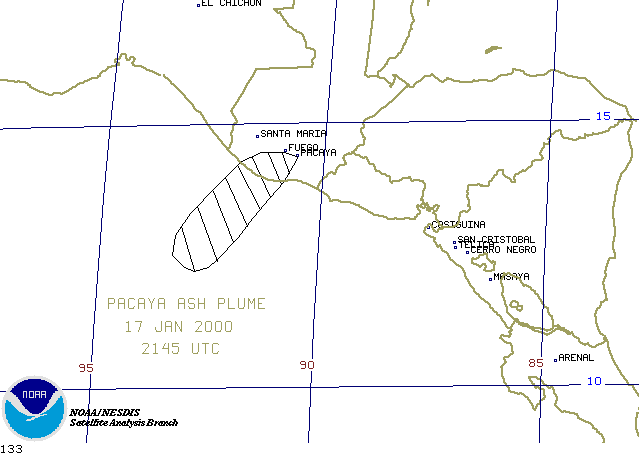 These
algorithms require input about the eruption and the meteorological
conditions and assume simple particle shapes and generally do not
incorporate the possibility of particle aggregation.
These
algorithms require input about the eruption and the meteorological
conditions and assume simple particle shapes and generally do not
incorporate the possibility of particle aggregation.
Future Needs
In order to better predict the fallout of volcanic ash a better understanding of how ash actually falls out from the atmosphere is needed. Factors that are assumed in the presently used forecasting models do not accurately describe the physical characteristics of ash particles and do not account for particles sticking to each other and then falling faster than predicted.
| Michigan Tech Home | Department of Geological Engineering & Sciences | Remote Sensing Institute | MTU Volcanoes Page | Volcanic Clouds Web Site | Total Ozone Mapping Spectrometer (TOMS) | Volcanic Ash Advisory Centers (VAAC) | Smithsonian Institution | Alaska Volcano Observatory |
http://www.geo.mtu.edu/volcanoes/vc_web/overview/o_ashfall_forecasts.html -- Revised: 06 NOVEMBER 2000
Copyright © 2000 MTU
Department of Geological Engineering and Sciences. All Rights
Reserved.
Email
questions about the content of this Web page to: kjmacpha@mtu.edu