



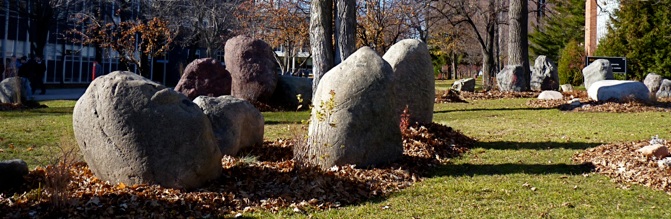
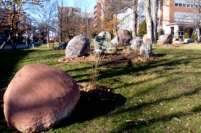
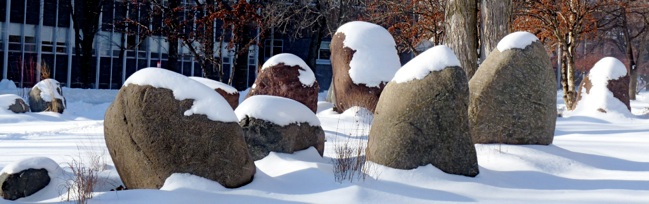
For 40 years I have noticed that glacial boulders are abundant and beautiful in the copper country, but they are underutilized for their educational, research and artistic potential. I have looked constantly for excellent examples, finding an occasional gem, but never a collection that is together of great interest until now. This past summer, while working on the design of a field class in earth sciences, I entered the Mohawk Sand and Gravel quarry between Ahmeek and Copper City. There, as part of a much larger group of boulders harvested from glacial outwash, I found an extraordinary group of about 30-35 boulders which are naturally-shaped (glacially transported) examples of all the major rock types of the Peninsula, including dramatic examples of the important individual rock types that come from solidification of huge lava flows (Vesicular flow tops, fissures, pegmatites, ophitic portions), conglomerates, sandstones. We supplemented that collection with two excellent boulders that were already on campus, near the SDC. Each of the boulders is a museum specimen, but they are larger and more robust than those stored inside. They have been outside for decades and do not need shelter. The size of these rocks is mostly 1-2 m in diameter. They have been arranged artistically in a small plaza to allow for people to walk around them. They will be supplemented with educational materials which are being developed for research and teaching purposes. They can be used in geological and material science classes and would also be an attraction to visitors. The timing and conception of this project was was triggered by the MiTEP research project about earth science teaching, sponsored by the US National Science Foundation which emphasizes hands on teaching of field topics. This project very much speaks to that need, and it is expected to be a model for similar projects on other campuses. The garden also reflects a new international focus on Geoheritage.
A geological art project of research and educational value for Michigan Tech
The use of the Boulder Garden is envisioned for geological laboratories in a number of classes where research about teaching is especially highlighted. The advantage of such a collection is that it groups in one place excellent examples of a broad variety of rocks that represent dozens of different places which can be examined all at once. In addition, the rocks are large enough that they contain much more information than small pieces of rocks. In one two hour class session students can observe and analyze data that could only be done from many days of field work, if they were to examine the same diversity of rocks.
Boulder News!
Italy: Giant Boulder and Old House
Other Boulder Garden Examples:
Ohio’s Geological Walk Through Time
Waterloo University--Peter Russell Garden
Emporia St Univ--Kansas Rock Garden
Assembling California Garden - UC Davis.




Bill Rose
Professor of Petrology
15 November 2010