|
|
|
Announcements
& Notices
| |
These
are all 2003-2004 academic year announcements |
| |
Geo-Club
Field Trip
April 16-17 there will be a field trip to Wausau, Wisconsin
area.
To summarize the trip, we would leave Friday Afternoon (when
everyone is done with class) and try to hit one outcrop for
kyanite on the way in Iron County, WI. Then Saturday, we're
visiting a granite quarry and looking for some feldspar that
is similar to a moonstone or labradorite. There may be another
few places we'll try to get into, but as of now, this is all
that is for certain.
Granite
Quarry
the
feldspar material (labradorite/moonstone) - not going
to exact location mentioned on the page.
We may try to hit one other quarry around Wausau that mines
weathered granite for roads. These "rotten granite" quarries
are sometimes cut by pegmatite dikes, but I guess it is pretty
much hit and miss. If interested in going e-mail me (demoore@mtu.edu)
and I'll get everyone together to figure out final arrangements
for the trip in a week or so. |
| |
The Department of Geological
and Mining Engineering and Sciencesis
pleased to announce the following speaking engagement:
TUESDAY, APRIL 20 - 4:00 P.M. DOW 641
DR. WM. SCHOPF - PROFESSOR OF PALEOBIOLOGY, UCLA
"EARTH'S EARLIEST FOSSILS:SOLUTION TO DARWIN'S DILEMMA"
ABSTRACT In 1859, in On the Origin of Species, Darwin repeatedly
pointed to what he viewed as the greatest challenge facing
his theory of evolution -- the lack of a rich fossil record
predating the rise of shelly invertebrate animals that marks
the beginning of the Cambrian Period of geological time (~550
million years ago).
A scientist to the core, Darwin faced the problem straight
on, arguing that the lack of such a record was "inexplicable"
-- an absence that could be "truly urged as a valid argument"
against his theory. For more than 100 years, the missing Precambrian
history of life stood out as one of the greatest unsolved
mysteries in natural science. In recent decades, however,
life's early history has finally begun to be unearthed as
the documented fossil record has been extended to some 3,500
million years ago, an age more than three-quarters that of
the planet itself. As this new science has matured, hundreds
of ancient fossiliferous units have been discovered and the
rules for accepting ancient microfossil-like objects as bona
fide have come to be well established -- namely, that such
objects be demonstrably biogenic, and indigenous to and syngenetic
with the formation of rocks of known provenance and well-defined
Precambrian age.
In the past few years, two new techniques have been devised
to help answer the question of biogenicity, the most vexing
of the criteria to satisfy. Founded on firm understanding
of the morphology and physiology of extant microorganisms
and a large body of data on the maturation of organic matter
in geologic settings, for the first time these techniques
provide means to correlate directly cellular morphology with
organic composition in individual Precambrian microscopic
fossils.
(1) Ion microprobe spectroscopy has been used to measure
the carbon isotopic composition of single microscopic fossils(1,2),
analyses that provide evidence of their ancient physiologies.
(2) Laser-Raman imagery has been used to determine the chemical-structural
composition of such fossils -- both in two and in three dimensions(3-5)
-- data that confirm the biological origin of the carbonaceous
matter comprising their petrified cell walls and that demonstrate
the presence of cell lumina, the cellular spaces that define
biological systems. After more than a century of unrewarded
search, an immense early fossil record, unknown and assumed
unknowable, has been unearthed to reveal a microbe-dominated
evolutionary progression that stretches seven times farther
into the geologic past than had previously been imagined.
For more information regarding Dr. Schopf's visit please
contact Dr. James Wood, jrw@mtu.edu or 487-2894. |
| |
The
April meeting of the AAPG, SEG, and Geology Club
Tuesday, April 13 at 6 pm in Dow 610. Subs will be provided
for dinner.
Fred Bailey will be giving a presentation on the mining,
geology, and mineralogy if the Nanisivik Mine. Topics to be
discussed at the business meeting include the field trip to
the Wausau, WI area, a possible geology club trip (May 1)
to Caledonia Mine, and of course officer elections. If you
were nominated for a position last month, be sure to attend
this meeting. Hope to see everyone there. Katrina Settles |
|
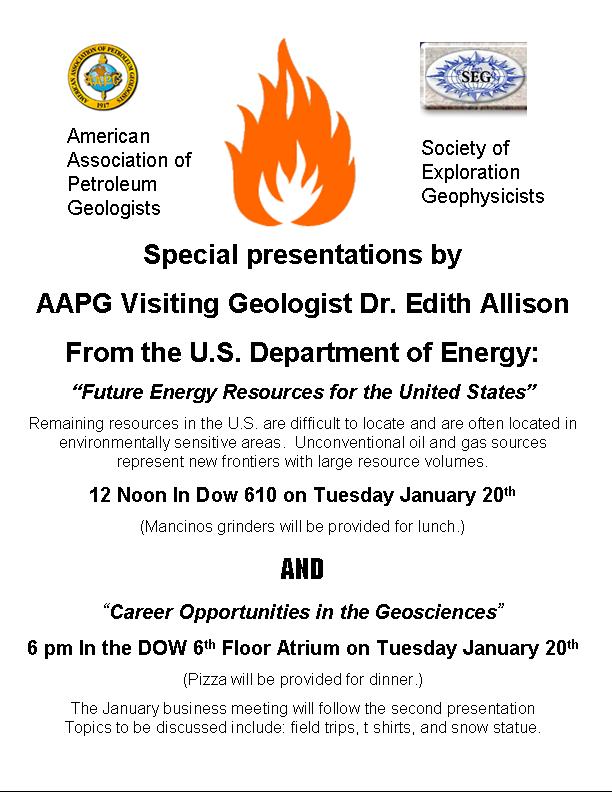
AAPG
Jan 2004 Meeting
Visiting DOE Geologist
Dr. Edith Allison
12 Noon Dow 610
Tuesday Jan 20th
Grinders from Mancinis
Click
for Details |
| |
HAPPY
HOLIDAYS
The department's annual holiday party will be held Thursday,
12/4/03, from 12:00 to 2:00 p.m. in the Robbins Atrium, Dow
632. The department will provide a meat and cheese tray, rolls,
and drinks. If you could bring a dish to pass that would be
appreciated. Thanks and we look forward to seeing you there. |
| |
Dr. Jimmy F Diehl, Professor,
Geophysics, Michigan Tech
"Using mineral magnetic properties
to construct a paleoclimate record: An example from the entrance
facies sediments of Kulna Cave, Czech Republic"
Dow 641
4:00 p.m. Wednesday November 19 |
| |
JOINT PHYSICS/REMOTE
SENSING INSTITUTE SEMINAR OCT. 22
Azadeh Tabazadeh, a senior scientist at NASA Ames Research
Center, will present, "The Effect of Crystallization
Process in Clouds on Atmospheric Chemistry and Climate,"
Wednesday, Oct. 22, 4-5 p.m. in Dow 641. Tabazadeh has been
featured in Science News, was named one of Popular Science's
"Brilliant 10" in 2002 and received the American
Geophysical Union's James B. Macelwane Medal in 2001. The
Macelwane Medal is awarded to young scientists for significant
contributions in geophysics. The abstract for the seminar
can be found at http://www.rsi.mtu.edu/seminar_current.html
. |
| |
MTU DEPT. OF GEOLOGICAL AND MINING ENGINEERING
AND SCIENCES PRESENTS A SEMINAR
AN OUTDOOR DEMONSTRATION
OF SIDE SCAN SONAR
Where: Abord the MTU Research Vessel Agassiz.
Meet at the dock by
the MTU Physical Plant
When: Wednesday, September 17.
Demo 1*: 8:30 to 11:30 AM to South Portage Entry to view
a
shipwreck and coastal processes
Demo 2*: 12:30 to 1:30 PM to view industrial jetsam including
stamp sands from MTU going west in the Portage
Demo 3*: 2:30 to 3:30 PM to view industrial jetsam including
stamp sands from MTU going east in the Portage. (Sorry that
this interferes with the President's Convocation at 3 PM).
*Space on the Agassiz is limited to 18 persons total. Please
contact me by e-mail to sign up. Please indicate your preferred
time and leave your phone number. (Contact Chuck Young ctyoung@mtu.edu
487-2072).
Side scan sonar is used to produce images of underwater geology
and sunken objects. Common targets are shipwrecks, snowmobiles
that have fallen through the ice, and drowning victims. nthropogenic
targets for side scan. It is also used to produce images of
underwater sediment deposition (natural or man-made, such
as mine tailings), and other features of the lake bottom such
as grooves made by ice. McQuest Marine Sciences Limited, in
Burlington, Ontario is providing a Sport Scan sonar made by
Imagenex (BC Canada) for demonstrations at MTU. This equipment
is highly portable, and is powered by a 12 volt car battery.
The electronics is in the sensor fish, which weighs about
25 pounds in air. The only other equipment required in the
boat is a laptop computer and a GPS. In winter, the equipment
can also be deployed by lowering it through a hole in the
ice and turning it to obtain a radial scan. This demonstration
should appeal limnologists, geologists, environmental engineers,
industrial archeologists, and law enforcement.
*Space on the Agassiz is limited to 18 persons total and
I am required to have a list of passengers before leaving
the dock. Please contact me by e-mail to reserve a spot on
the boat, and indicate which time you wish to go, also leave
your phone number. (Contact Chuck Young ctyoung@mtu.edu 487-2072).
I will NOT be providing refreshments. Bring your own water
bottle. There is no toilet on the boat, so go before you go.
The main expense of this demonstration is the cost of the
boat. If you would like another demonstration during the week
of Sept. 15 to 19, and if you could provide a boat with a
cabin or sunshade, please contact Chuck Young (ctyoung@mtu.edu
487-2072). The cabin is needed to shade the computer screen.
Relevant URLs:
The manufacturer's home page is: http://www.imagenex.com/Products/SportScan/sportscan.html
Basic principles are discussed at: http://www.marine- group.com/SonarPrimer/SideScanSonar.htm
Awesome side scan images are presented at: http://www.marinesonic.com/archives.html
|
| |
Geology
Club, SME, NSSGA
Questions: cacamero@mtu.edu
|
| |
National Council of Examiners for Engineering and Surveying
(NCEES)
Please note the following:
Effective December 2001 all Michigan candidates must contact
the National Council of Examiners for Engineering and Surveying
(NCEES) to register for future examinations.
The Michigan Board of Professional Engineers website is http://www.cis.mi.us/bcs/pe
and their phone number is 517/241/9253.
The address for the National Council of Examiners for Engineering
and Surveying (NCEES):
PO Box 1686
280 Seneca Creek Road
Clemson, SC 29633-1686
Phone 877-536-7729 or 864-654-6824
Fax 864-654-6033 |
Previous
Announcements Link
Updated: 01/16/04
© MMIII
Department of Geological & Mining Engineering & Sciences
Michigan Technological University
1400 Townsend Drive
- Houghton, MI 49931-1295
(906) 487-2531
|
|